virtufin-tui
virtufin-tui is the operator dashboard for the Virtufin platform. It connects to
virtufin-api and renders the full control plane — workers, WebSocket connections
(WebSocketFeed workers), state store, live CloudEvents — in a single keyboard-driven screen.
The web app is the sibling client: https://app.docs.virtufin.com/. Both follow the same navigation structure, read the same shared feed definitions, scenarios and pages, and offer the same operation catalog to their AI assistant.
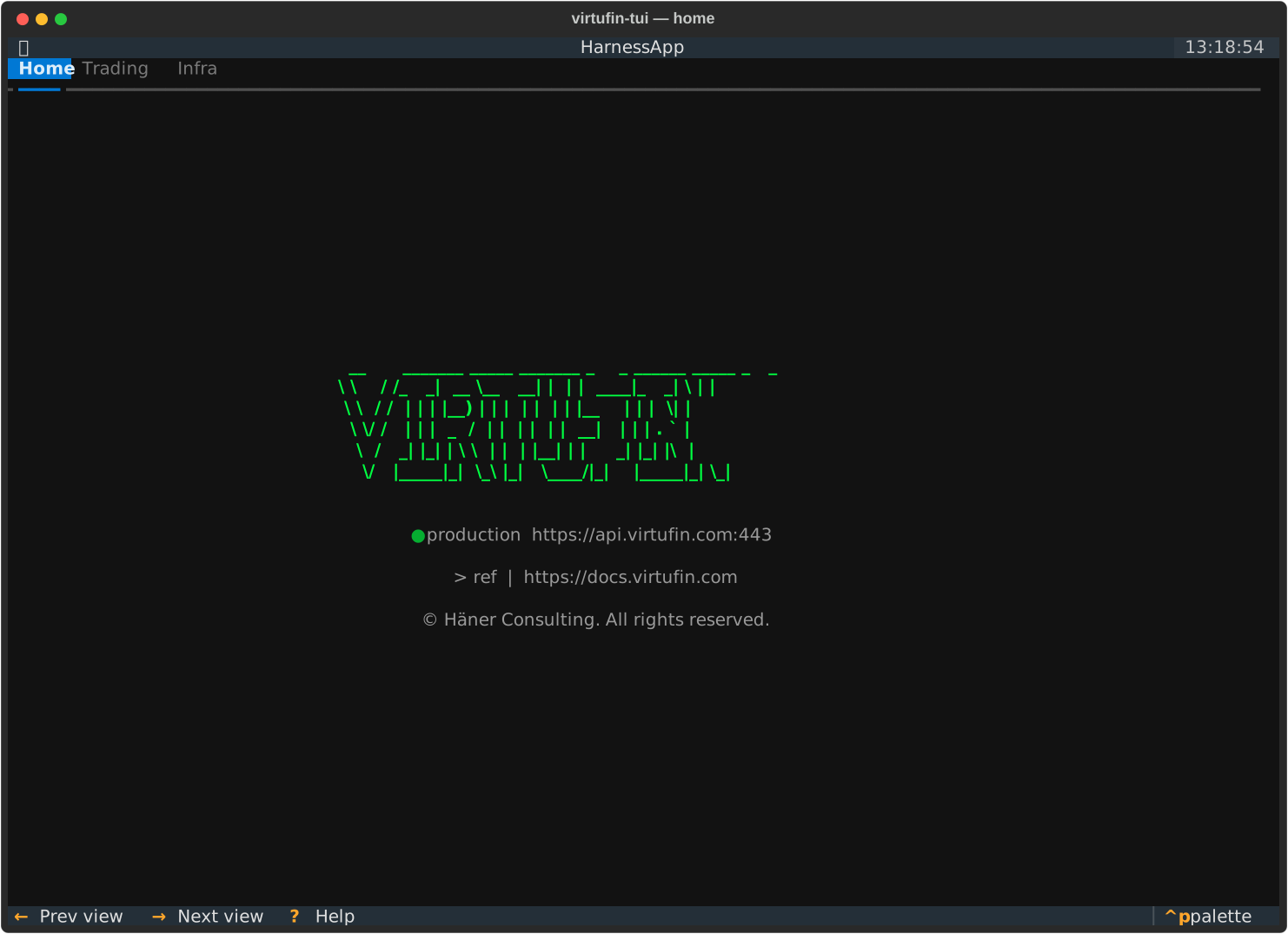
The default layout
The tabs are the navigation structure in use (see Tabs, pages & custom panes). With the built-in default they are:
Top tab (←/→) |
Sub-tabs (keys 1-9) |
|---|---|
| Home | — |
| Trading | 1 Feeds, 2 Instruments, 3 Order Book, 4 Indicators, 5 Portfolio, 6 P&L, 7 Risk, 8 Strategy, 9 Scenario |
| Infra | 1 Workers, 2 Connections, 3 Triggers, 4 States, 5 EventStores, 6 Alerts, 7 Changes, 8 Events, 9 Services (a placeholder: the TUI has no Services view) |
| Config | 1 Pages, 2 Navigation (the contexts table and your navigation), 3 Scripts, 4 AI |
ctrl+p opens the command palette (Go to <tab> › <pane>, Switch context to
<name>, the current page's keys); ? shows the keys of the current page; K is the
kill switch on every tab.
Pages on this site
Home
- Getting started: install, first run,
contexts.toml. - Contexts: several
virtufin-apiendpoints, switching, protected contexts.
Screenshots: a tour of every tab and pane.
How-tos: step-by-step tasks — set up AI, switch context, connect a feed, start and upgrade a worker, schedule a trigger, scenarios and the trading halt, compose a strategy, browse state and events, run a script, make a page, find what went wrong.
Reference
- Keybindings: every key on every pane, filtering, representations.
- AI tab: providers (
llm_providers.toml), tools, privacy. - Scripts: the Scripts pane, the env-var contract,
init_scripts. - Tabs, pages & custom panes:
navigation.json, shared pages, custom panes. - The TUI's API: how the operation catalog is reached from the TUI.
Architecture: data flow, stores, liveness, the client.